What benefits do India's top companies offer?

HR leaders, CHROs, founders, and rewards teams in India are increasingly benchmarking employee benefits by global companies like Google, TCS, Accenture, Deloitte and others to understand what “competitive” means in high-skill talent markets. The answer is no longer limited to salary bands, health insurance, or annual bonuses. India’s best employers are building employee ecosystems around family support, financial wellness, device benefits, flexibility, learning, mental health, and work infrastructure.
74% employees prioritise long-term benefits over bigger paychecks as per the report. Employees are weighing total rewards more carefully, especially where health coverage, family support, financial planning, hybrid work infrastructure, learning, and mental health access affect daily life.
The details of any company’s benefits can vary by role, level, location, business unit, employment type, and policy updates. This benchmarking view focuses only on publicly available India-relevant information and should not be treated as legal, tax, payroll, or HR compliance advice.
The India benefits benchmark
India’s top employers now compete on a full rewards experience, not a benefits brochure. Compensation still matters, especially in technology, consulting, and digital roles, but employees increasingly judge an employer by how well it supports their work, family, health, growth, and long-term financial security.
Zinnov reports that 95 percent of GCCs are actively reinventing employee benefits, 67 percent use AI-powered rewards platforms, and 52 percent have retention bonuses built into their structures.
The strongest benefits portfolios usually combine several layers:
- Health and dependent coverage, including medical insurance for employees, spouses, children, and sometimes parents.
- Mental health and wellness, including counselling, wellness apps, emotional support, and stigma-free access.
- Parental leave and family care, including childcare support, surrogacy support, caregiver support, and family-inclusive policies.
- Wealth creation, including equity, RSUs, ESPP, PF, VPF, NPS, gratuity, and retirement planning.
- Hybrid work support, including flexibility, internet or smartphone subsidies, secure devices, and work-from-home enablement.
- Learning and career mobility, including certifications, internal movement, mentorship, and leadership development.
Benefits are no longer “nice-to-have” perks outside the main employee value proposition. They signal culture, reduce daily friction, and create stronger reasons to stay when competing offers appear.
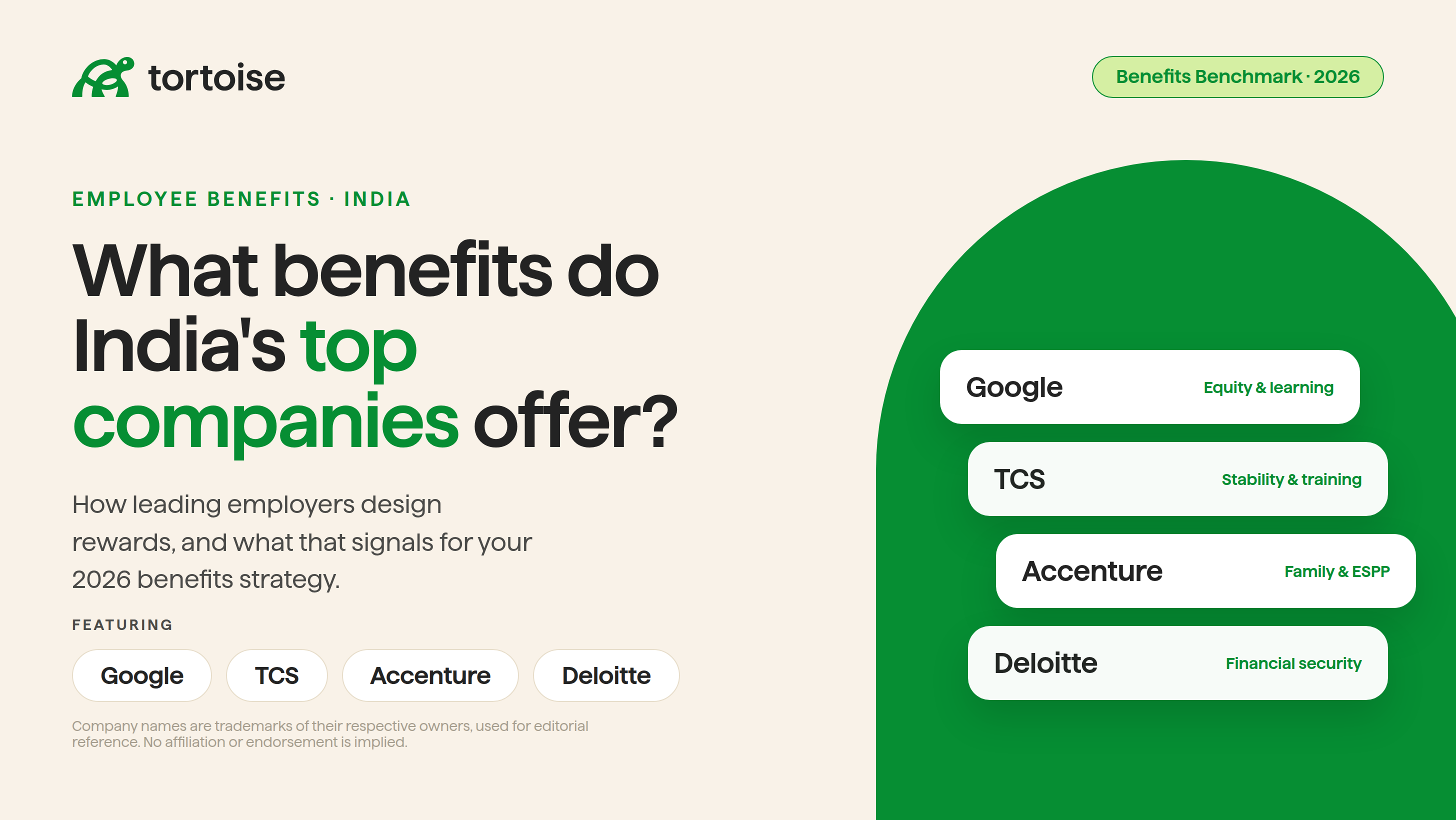
Different employers reflect different philosophies.
- Google India is often associated with innovation, high compensation positioning, stock-linked rewards, flexibility, and strong employee experience.
- TCS is associated with scale, stability, training, and long-term career continuity.
- Accenture India brings a structured model around inclusion, family care, mental health, and wealth-building.
- Deloitte India and its US-India offices show how financial security, work-life support, subsidies, and professional growth can sit inside a formal rewards framework.
That does not mean HR teams should copy these programs line by line. A fresher may value training, insurance, predictable growth, and job stability. A mid-career employee may care more about childcare, hybrid work, wealth-building, mental health, and internal mobility.
Good benchmarking starts with segmentation. The right question is not, “What does Google offer?” It is, “Which benefits solve the most important retention, productivity, and trust problems for our workforce?”
Google employee benefits in India
Google employee benefits attract attention because they represent a premium technology employer model. In India, the public narrative around Google’s benefits usually centers on strong compensation, stock-linked rewards, learning, autonomy, wellness, and an innovation-led culture.
Publicly available research cites Google India for strong salary positioning, RSU-linked stock benefits, structured mentorship, learning opportunities, mental health spaces, and references to “20% time” for personal projects.
Google’s model shows how rewards can support high-performing employees beyond pay. Stock-linked rewards encourage long-term participation in company growth. Mentorship and learning create visible development pathways. Flexibility and autonomy help employees feel trusted to solve hard problems without excessive process friction.
This matters in India because high-skill talent often evaluates the full employment experience. A software engineer, product manager, data scientist, or cloud specialist may ask: Will I learn faster here? Will my manager support experimentation? Will I have flexibility when family needs arise? Will the company invest in my long-term career, not just my current output?
Benefits should reinforce the behaviors the company wants: innovation, ownership, continuous learning, wellbeing, and high trust.
A smaller Indian technology company may not offer Google-level RSUs. But it can create strong learning budgets, structured mentorship, internal hack days, mental health access, manager training, and transparent promotion pathways. These benefits may cost less than premium compensation but can materially improve employee confidence.
TCS, Accenture and Deloitte employee benefits
TCS, Accenture, and Deloitte are useful benchmarks because they represent three distinct approaches to rewards in India. One emphasizes stability and scale, another emphasizes inclusion and life-stage support, and the third emphasizes structured financial security and professional development.
TCS employee benefits: Stability, scale and career foundation
TCS has long stood for scale, predictable career entry, foundational technical training, and long-term employability rather than a “perk-heavy” employer brand.
A first job in a large enterprise environment offers training discipline, exposure to delivery systems, project structures, professional norms, and internal movement opportunities. These benefits may not appear as line items in a rewards statement, but they shape career outcomes.
Public research positions TCS as strong on job security perception, large-scale training, early-career development, and stable long-term progression, especially for freshers entering India’s IT services ecosystem. That stability can reduce anxiety in volatile markets, particularly when employees support families or pay education loans.
This model is especially relevant for companies hiring from campuses or tier-2 and tier-3 cities. Employees in these segments may prioritize structured learning, manager support, career pathways, and reliable salary continuity over premium lifestyle benefits. A well-designed training ecosystem can become a retention engine when employees see that staying helps them become more employable.
Accenture employee benefits
Accenture’s India benefits page lists several notable programs, including 26 weeks of paid parental leave, an Employee Stock Purchase Plan with a 15% discount, “Benefits You” elements such as family care and OPD coverage, and mental health support through tools such as Wysa and Calm, according to Accenture’s India benefits information. The same source also highlights inclusion and diversity priorities, making the benefits model broader than compensation alone.
Accenture’s model is a strong example of life-stage benefits. A young employee may value learning pathways and wealth-building. A new parent may value leave, childcare-related support, and mental health resources. An employee managing elderly parents may value outpatient support and flexibility.
The HR takeaway is to avoid designing benefits only for the “average employee.” There is no average employee in a large Indian workforce. A coherent rewards strategy should give different groups meaningful support without becoming administratively chaotic.
Deloitte employee benefits
In India, the Deloitte model is often discussed around retirement-linked benefits, insurance, work infrastructure support, childcare reimbursements, car leasing for eligible levels, and professional development.
Deloitte’s benefits information lists financial security elements such as PF, VPF, gratuity, and NPS-related benefits, along with car leasing programs for eligible senior levels, smartphone and internet subsidies, childcare reimbursements, medical insurance that covers pre-existing conditions from the date of joining without medical checks, and professional development support through certifications and tuition reimbursement, as described on Deloitte’s benefits and rewards page. These benefits may vary by entity, level, role, location, and current policy, so they should not be treated as universal entitlement.
This model treats financial planning as part of the employee experience. PF, VPF, gratuity, and NPS-related benefits support long-term security. Car leasing can be relevant for senior employees where policy, eligibility, usage, and tax treatment are carefully structured. Smartphone and internet subsidies recognize that work infrastructure has moved beyond the office desk.
Deloitte’s model also shows how professional growth can sit beside financial benefits. Certifications and tuition reimbursement can strengthen both employee capability and client delivery. For consulting and professional services firms, this creates a useful exchange: the employee gains marketable skills, and the company strengthens expertise.
How Amazon, IBM, Flipkart and Wipro fit into the India benefits conversation
Google, TCS, Accenture, and Deloitte are strong anchors, but they are not the only useful benchmarks. Amazon, IBM, Microsoft, Salesforce, Flipkart, and Wipro broaden the conversation by showing how family realities, hybrid work, global policy influence, Indian scale, and workforce diversity shape benefits design.
Amazon employee benefits India
Amazon employee benefits India are important because they show how large employers can design benefits around the employee’s broader life ecosystem. In India, that ecosystem often includes children, spouses, parents, elderly dependents, and complex family responsibilities that directly affect work performance and stress.
HRKatha’s coverage of Amazon India describes an employee ecosystem approach that includes support for dependents, children’s mental health up to age 17, and support around life events such as surrogacy and gender reassignment. This is a meaningful shift from employee-only benefit design.
When an employee’s child needs mental health support, or when an employee is navigating a major life event, the workplace benefit becomes a stabilizer. It can reduce absence, emotional strain, and the feeling that the employee must choose between family responsibility and career continuity.
Many employees support parents, in-laws, children, spouses, siblings, or extended family. Benefits that acknowledge this reality often create deeper emotional loyalty than isolated lifestyle perks.
This does not mean every company can offer every form of support immediately. A phased approach may work better. HR teams can begin with dependent coverage clarity, mental health access for family members, caregiver leave, inclusive family definitions, and confidential support channels.
IBM employee benefits and the hybrid-work caution for India
IBM employee benefits are often searched in the context of hybrid work, flexibility, and enterprise policy design.
Hybrid work sounds simple when described as a benefit. In practice, it touches payroll, cybersecurity, data access, manager behavior, performance evaluation, location approvals, and sometimes tax or legal review. Cross-border and location-sensitive remote work can also require approvals and compliance checks, a challenge reflected in WFA’s analysis of IBM’s remote work policy considerations.
An employee working from Bengaluru, Pune, Gurugram, Hyderabad, or a hometown location may have different work infrastructure, connectivity, manager visibility, and collaboration rhythms. If policy rules are unclear, flexibility can create perceived unfairness.
HR leaders should define eligibility, approved work locations, data security expectations, attendance norms, expense treatment, and performance evaluation standards. Managers also need training to avoid proximity bias, where office-visible employees receive more attention, better projects, or faster promotion consideration.
Flipkart employee benefits and Wipro employee benefits
Flipkart employee benefits and Wipro employee benefits deserve attention because India-based and India-scale employers often offer more practical comparisons than global tech giants. Flipkart represents a large Indian digital commerce environment, while Wipro represents enterprise-scale IT services with a diverse workforce across roles, locations, and client delivery models.
These companies help understand benefits under Indian cost structures, operating complexity, and workforce diversity. A global tech company may set expectations for premium benefits, but an Indian-origin employer often shows what scaled benefits look like across thousands of employees with varied compensation levels and job types.
The deeper lesson is that benefits design must fit the business model.
A digital commerce company may need benefits that support fast-paced operations, logistics-adjacent teams, product talent, and technology teams.
An IT services company may need benefits that work across client sites, delivery centers, campuses, and hybrid roles.
For Indian employers, Flipkart, Wipro, and TCS show that scale changes everything. The best benefit is not always the most premium one. It is the one that can be delivered consistently, explained clearly, governed well, and valued by the workforce.
Benefit categories Indian HR leaders should compare before redesigning rewards
Company-by-company benchmarking is useful, but benefits decisions should ultimately be made by category. HR teams need to know which parts of the rewards portfolio solve which employee problems, and which ones create payroll, compliance, or communication complexity.
1. Health, mental wellness and family care
Top Indian employers are expanding beyond basic group mediclaim. Medical insurance remains the foundation, but employees increasingly expect support for dependents, OPD needs, preventive care, counselling, mental health apps, childcare, parental leave, and family-sensitive policies.
Accenture, Deloitte, and Amazon India show different sides of this shift. Accenture’s model highlights parental leave, OPD, family care, and 24/7 mental health support. Deloitte’s benefits emphasize insurance structure, including pre-existing condition coverage from joining where applicable. Amazon India’s approach adds the family ecosystem lens, including children’s mental health and support for complex life events.
For an employee managing a child’s therapy sessions, a parent’s recurring consultations, and their own deadlines, OPD coverage or family counselling support can feel more valuable than a generic wellness webinar. The benefit works because it removes real-life friction and gives employees permission to address personal needs without hiding them.
HR teams should also examine inclusivity in family definitions. Do policies support single parents, adoptive parents, LGBTQ+ employees, surrogacy, gender-affirming care, eldercare, or non-traditional caregiving responsibilities? The answer affects how employees experience fairness.
A practical benefits review should ask:
- Who is covered? Employee only, spouse, children, parents, in-laws, partners, or other dependents.
- What is covered? Hospitalization, OPD, mental health, maternity, fertility, preventive care, or long-term treatment.
- How easy is access? Cashless network, reimbursement process, app-based support, confidentiality, and turnaround time.
- How well is it communicated? Employees need plain-language explanations, not policy PDFs alone.
Family-aware benefits can improve emotional loyalty because they support the employee’s real life, not just their office identity.
2. Device benefits and work infrastructure
Device benefits now sit inside the broader rewards conversation because laptops, smartphones, tablets, and work accessories directly affect productivity, hybrid work readiness, and employee experience. For many Indian employees, especially in mid-to-high tax brackets, buying premium work technology from post-tax income can feel expensive, even when the device is essential for their role.
HR leaders should compare whether their current approach is still built around ad-hoc reimbursements, one-time WFH allowances, or employee-funded purchases. These models are simple to launch but often create uneven access, manual claims, unclear ownership rules, and additional coordination between HR, payroll, finance, and IT.
A more structured option is a salary-sacrifice device benefit program. Under this model, employees can access approved devices through an employer-enabled leasing structure, with deductions made from gross salary through payroll. When designed correctly, this can make the benefit tax-efficient for eligible employees while remaining cost-neutral for the employer.
This is where platforms like Tortoise fit into the rewards stack. Rather than positioning devices as a discretionary perk, Tortoise helps Indian companies turn technology access into a managed employee benefit, covering payroll integration, insurance, care packages, and device lifecycle management. For teams, the value is not just better devices for employees; it is a cleaner, more compliant way to offer work infrastructure without increasing direct compensation budgets.
3. Financial wellness, retirement and tax-aware benefits
Financial wellness matters deeply in India because employees evaluate compensation through take-home pay, tax treatment, savings potential, and long-term security. A salary hike is visible, but structured benefits can sometimes create higher perceived value when they help employees plan better.
The key is responsible communication. HR teams should not promise guaranteed tax savings or investment outcomes. Benefits such as NPS, VPF, car leasing, payroll deductions, stock purchase plans, and RSUs should be reviewed with payroll, finance, legal, and qualified tax advisors before rollout and employee communication.
Consider a senior manager evaluating a car leasing benefit. The employee may see value in structured access to a vehicle, predictable deductions, and potential tax efficiency depending on policy and personal circumstances. But if eligibility, documentation, usage rules, and tax treatment are unclear, the same benefit can create frustration during payroll or tax filing.
Similarly, ESPP and RSUs can be powerful wealth-building tools, but they introduce concentration risk, vesting rules, taxation events, and market movement. A clear explainer on contribution limits, lock-ins, taxation triggers, and risk can make the benefit more trusted.
Financial wellness benefits can increase perceived compensation without relying only on salary hikes. But they work best when employees understand the mechanics and trust the governance behind them.
4. Hybrid work, flexibility and employee work infrastructure
Hybrid work is now both a benefit and a management challenge. Employees value flexibility, but companies must design it carefully across roles, locations, security needs, collaboration demands, and performance expectations.
Work infrastructure has become part of the benefit stack. Deloitte’s smartphone and internet subsidies are useful examples of how employers can recognize the practical cost of modern work. For many employees, a stable device, secure access, reliable internet, and responsive support are basic conditions for doing good work.
The difficult part is fairness. Hybrid employees may worry about visibility. Remote employees may fear slower promotion. Office-based employees may feel they carry more collaboration load. Managers may unintentionally favor employees they see more often.
Allowance design can also create trust issues. If remote workers lose certain allowances or receive different reimbursements, employees need a clear explanation. Otherwise, the change may feel like a hidden compensation cut, even when the company has a legitimate policy rationale.
HR teams should define:
- Role eligibility, including which roles can work hybrid and why.
- Location rules, including approved cities, client requirements, and security constraints.
- Infrastructure support, including devices, internet, software, and support channels.
- Performance norms, including how outcomes are measured across office and remote settings.
- Manager training, including how to prevent proximity bias.
Flexibility is strongest when employees see it as fair, secure, and sustainable. Without that, hybrid work becomes a source of negotiation rather than trust.
5. Learning, internal mobility and career progression
Learning is one of the most important benefits in India’s technology, consulting, IT services, and digital sectors. Employees know that skills age quickly. A company that helps them learn becomes more attractive, even when another employer offers slightly higher pay.
Learning benefits work because they address career anxiety. A fresher wants a strong foundation. A mid-career engineer wants to stay relevant in cloud, AI, cybersecurity, data, or enterprise platforms. A consultant wants certifications that strengthen credibility. A manager wants leadership development for larger roles.
Internal mobility is equally important. Employees are more likely to stay when they can move to new roles without leaving the company. This is especially valuable in large Indian organizations where employees may want to shift from delivery to product, support to consulting, testing to automation, or individual contributor roles to management.
The strongest learning programs connect training to opportunity. A course library alone is not enough. Employees need manager encouragement, project access, certification support, role pathways, and recognition for new skills.
For HR leaders, learning should be treated as a retention benefit, not only an L&D metric. When employees believe the company is increasing their market value, they are more likely to invest discretionary effort back into the organization.
What Indian companies can learn from top employer benefits
Google employee benefits highlight innovation, stock-linked rewards, flexibility, learning, and a premium employee experience. TCS employee benefits show the power of stability, training, and long-term career pathways. Accenture employee benefits demonstrate how inclusion, family care, mental health, and ESPP can work together. Deloitte employee benefits show the value of structured financial security, work-life support, and professional development.
The best lesson for Indian HR leaders is not to copy any one employer. The strongest benefits portfolio is the one that fits workforce demographics, business model, compliance requirements, payroll capability, and retention goals. Treat benefits as part of the employer value proposition, not just an annual HR cost, and evaluate every program by whether it makes employees healthier, more secure, more productive, and more likely to stay.
Frequently asked questions
What benefits are mandatory in India?
Indian employers must comply with statutory requirements such as EPF, ESI where applicable, gratuity after eligible service, paid leave under relevant laws and policies, and maternity benefits under the Maternity Benefit Act. These statutory benefits create the floor. Competitive employers add health insurance, mental health support, learning budgets, financial wellness, flexible work, and work infrastructure benefits on top.
What financial benefits does Deloitte offer?
Deloitte USI’s official benefits page lists PF, gratuity, voluntary NPS, medical insurance, car lease for eligible senior professionals, and wellbeing-related support. The same page states that medical insurance covers pre-existing conditions from the date of joining without health checks or waiting periods.
Why do device benefits matter?
Device benefits matter because hybrid and digital work depend on reliable laptops, smartphones, internet access, security tools, insurance, support, and replacement processes. Ad hoc reimbursements can help, but structured programs can improve employee savings, payroll clarity, asset handling, and lifecycle management when designed with proper tax and compliance review.
How do structured device benefits work under a salary-sacrifice model?
Under a structured device benefit program, employees select their preferred laptops, smartphones, or tablets, and the employer leases the assets on their behalf. The monthly lease payments are deducted directly from the employee's gross salary before tax, which reduces their overall taxable income and saves them up to 40% compared to retail purchases. The program is cost-neutral to the employer, as the leasing structure, insurance, and asset management are handled by an external partner.
Disclaimer: This guide is intended for general informational purposes only and should not be treated as legal, tax, payroll or accounting advice. Applicability of employee benefit laws in India depends on several factors, including the nature of the establishment, employee category, wage levels, location, headcount, employment terms and applicable central and state laws. Tax treatment of benefits may also vary depending on the structure adopted, documentation, payroll processing and the employee’s applicable tax regime. Employers should consult their legal, tax and payroll advisors before implementing or modifying any employee benefit programme.
Written by
Founder & CEO
Vardhan Koshal is the Co Founder of Tortoise, India’s fastest growing employee device benefit platform. He has led India growth and product for companies like TripAdvisor and Udacity, and earlier founded Ridingo, a car pooling startup recognised by Forbes as one of the Hottest Global Startups and acquired by Carzonrent. At Tortoise he works with HR leaders, CFOs and tax experts to design compliant, high impact device benefit programs for Indian employers.